How brands appear in AI assistants' answers, and how that connects to customer demand.
A young professional who has just started her first job asks an AI assistant: "Which bank would you recommend for a salary account?" The answer arrives in a few seconds: one bank first, a short explanation, and two alternatives below.
For a customer who trusts that answer, the search may end there. The bank named first is in a strong position before the customer has visited a single website. Banks that are not mentioned have no way of knowing the conversation took place.
A new place where brand decisions are made
Brand teams track awareness, reach and share of conversation on social media. None of these measures records what an AI assistant tells a customer who asks for a recommendation.
Recommendations from friends, review sites and forums have always shaped choices made when the brand is not present. AI assistants bring these sources together into a single answer, delivered at the moment a customer is deciding.
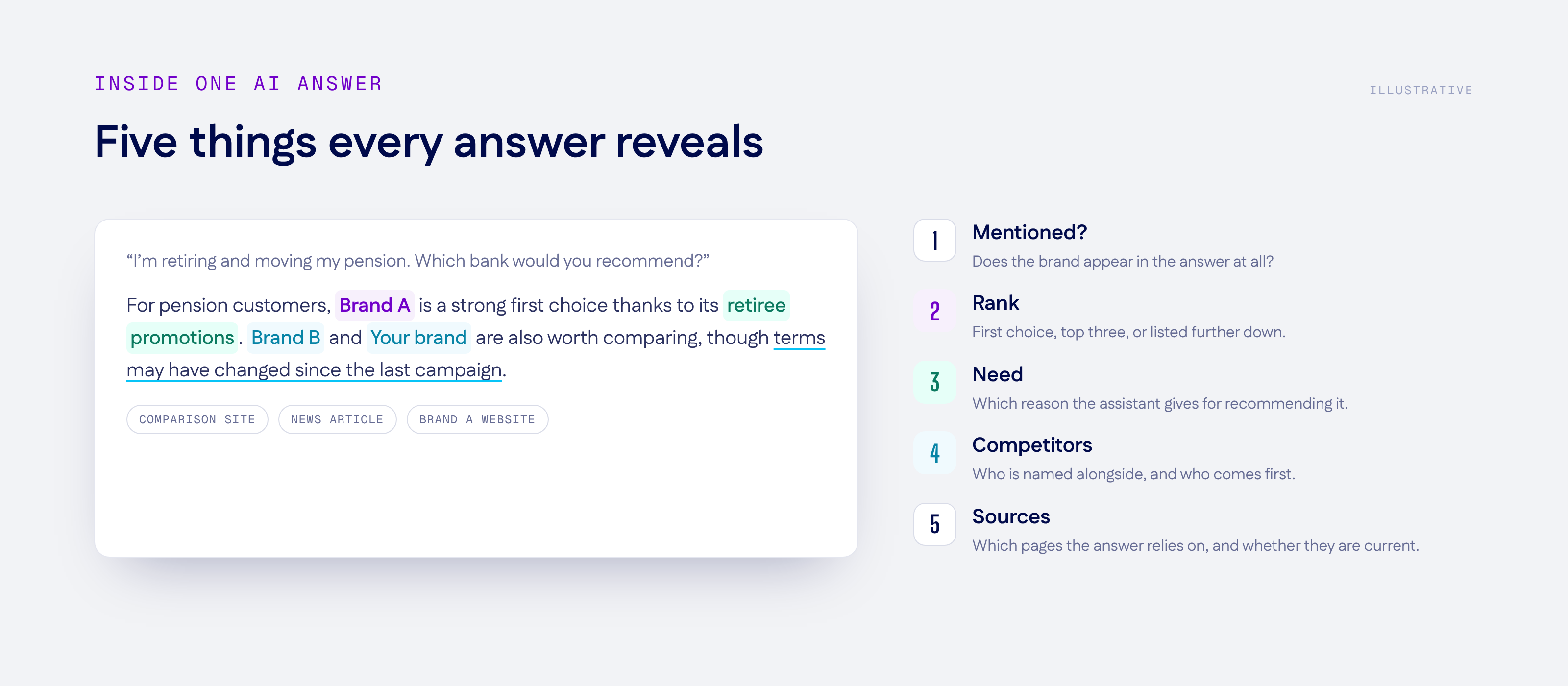
A single answer contains five details worth recording: whether a brand is mentioned at all, where it sits in the list, the reason the assistant gives for it, which competitors appear alongside it and which web pages the assistant drew on.
Being known is not the same as being recommended
An assistant can know a brand well, describe its products accurately and still recommend a competitor first. Awareness metrics would show this brand as healthy, while the customer reads it as one option among several.
Position works differently in a chat answer than on a search results page. On a results page, lower positions still receive clicks. In a conversational answer, the customer sees a short list, and the first recommendation is presented as the main option.
The reason for a brand's position is often visible in the answer itself. An assistant may associate a brand strongly with one topic, such as a long-standing sponsorship, and recommend it first only when that topic comes up. For everyday questions, such as choosing a credit card or opening a salary account, the same brand may not appear in the top three. These explanations show which customer needs the assistant does not link to the brand.
Results differ by customer type
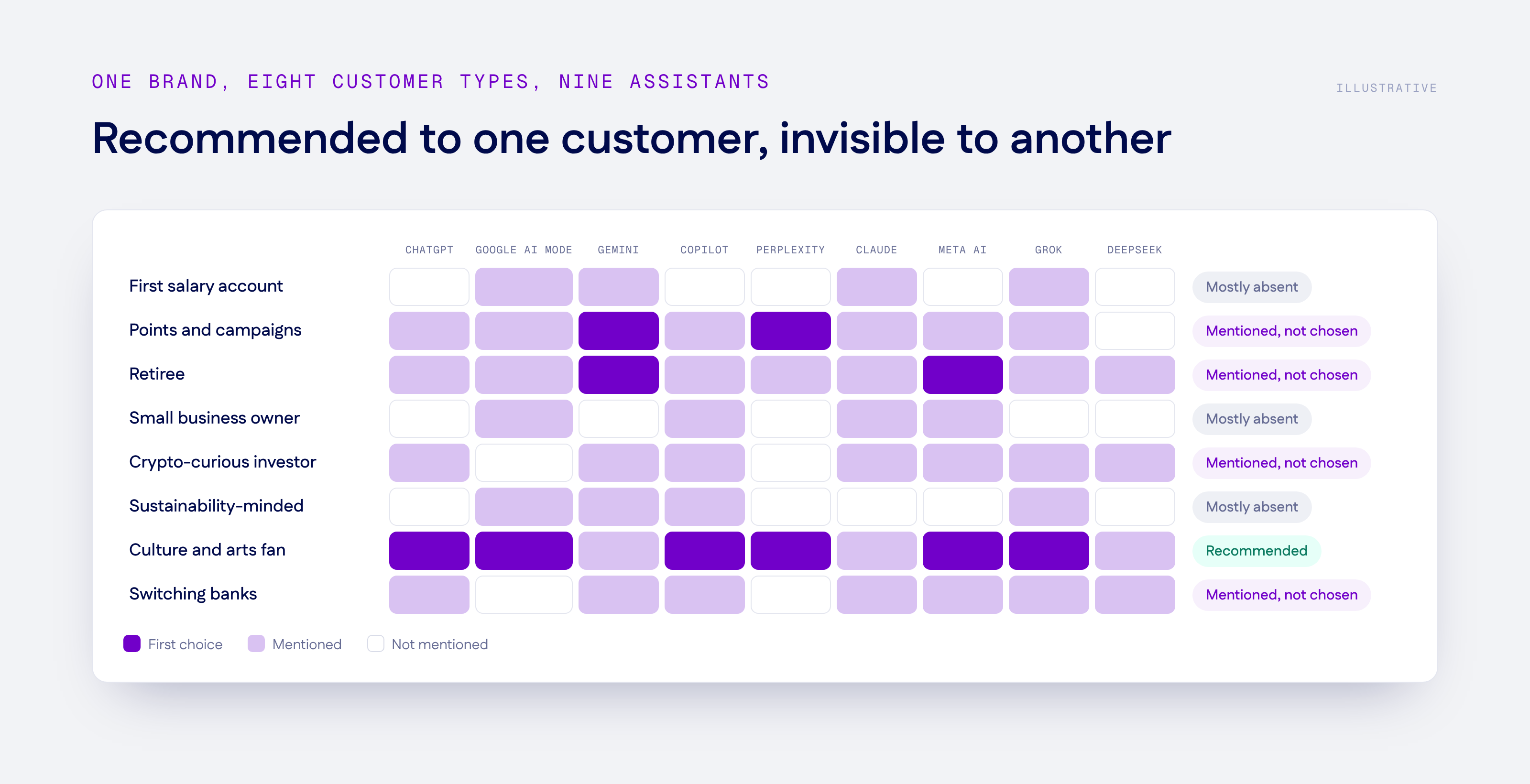
A retiree transferring a pension, a business owner looking for a commercial account and a POS terminal, a graduate opening a first salary account and a customer considering a switch all ask different questions. The answers differ too, so results are read by customer type as well as in total.
A single average can hide a brand that is the first choice for one segment and absent for others. A segment view shows where the brand is recommended, where it is only mentioned and where it does not appear.
Assistants rely on sources the brand does not control
When assistants cite their sources, the links can include comparison sites, news articles, forums and competitors' pages alongside the brand's own website. The information an assistant uses is therefore only partly in the brand's hands.
These sources can also be outdated. If an assistant draws on an expired campaign page or an old product detail, it may add a note advising the customer to check the current terms. Such a note sends the customer elsewhere to confirm the details.
The same applies to new campaigns. A launch that performs well on social media may not appear in assistant answers until the sites the assistants read have covered it. The delay between a launch and its first appearance in assistant answers can be tracked over time.
In ChatGPT, paid placement does not change this picture. OpenAI states that ads do not influence the assistant's answers and are kept separate from them, and advertising for financial services is restricted and approved case by case. The first position in an answer depends on the information the assistant can find and on how well that information matches the customer's need.

Connecting AI visibility to demand
AI Mindshare™ brings these observations into one measure. Customer questions, each written from the perspective of a specific customer type, are put to nine assistants (ChatGPT, Gemini, Google AI Mode, Copilot, Perplexity, Claude, Meta AI, Grok and DeepSeek) and repeated over time. For every answer, the measurement records the brand's presence, position, the reason given, the competitors listed and the sources used, and reports the results both in total and by customer type.
eBrandValue has measured brand switching on social media for more than a decade, identifying which people move toward a brand, which move away and which competitors they choose. Its work on sales-correlated social metrics placed third in the 2026 INFORMS Innovative Applications in Analytics Award.
From score to action
AI Mindshare is built as a diagnostic measure. The score shows where a brand's position is weaker, and the answers behind it show the cause: a need the brand is not associated with, a competitor recommended in its place or a page with outdated information. An outdated page is a task for the digital team; a missing association is a question for brand and content planning.
AI Mindshare is available as a standalone module or as part of the eBrandValue platform, where sales performance, customer movement on social media and recommendations in AI assistants can be followed together.
To see how your brand appears in AI assistants' answers, request a demo.
Frequently asked questions
What is AI Mindshare?
AI Mindshare is eBrandValue's measure of how AI assistants mention, rank and recommend a brand, which needs they associate it with and which competitors they suggest alongside it. Results are reported together with the answers and sources behind them.
How is AI Mindshare measured?
The same set of customer questions is asked in nine AI assistants, in the voice of different customer types, several times in each period. Each answer is scored by whether the brand appears and in which position, and the sources each assistant cites are recorded.
How is AI Mindshare different from Social Mindshare?
Social Mindshare measures a brand's share of the people talking about its category on social media. AI Mindshare measures how AI assistants recommend the brand. Comparing the two shows whether shifts in customer interest appear in assistant answers.
How can a brand improve its position in AI assistants' answers?
Start from the answers behind the score. Update pages that carry outdated offers or product details, make sure current information reaches the comparison sites and news sources that assistants cite, and plan content around the customer needs that assistants do not yet link to the brand.
To learn more about eBrandValue Platform, and how such metrics influence brand value, contact us using the form below.