For a while now, listening to the debates about artificial intelligence, I keep asking myself the same question: how much are we actually changing the way we work?
We prepare reports faster. We produce more content. Analyses that used to take hours now take minutes. All of this has value. But if we are making the same decisions, inside the same organizational structure, only faster, where are we in the transformation?
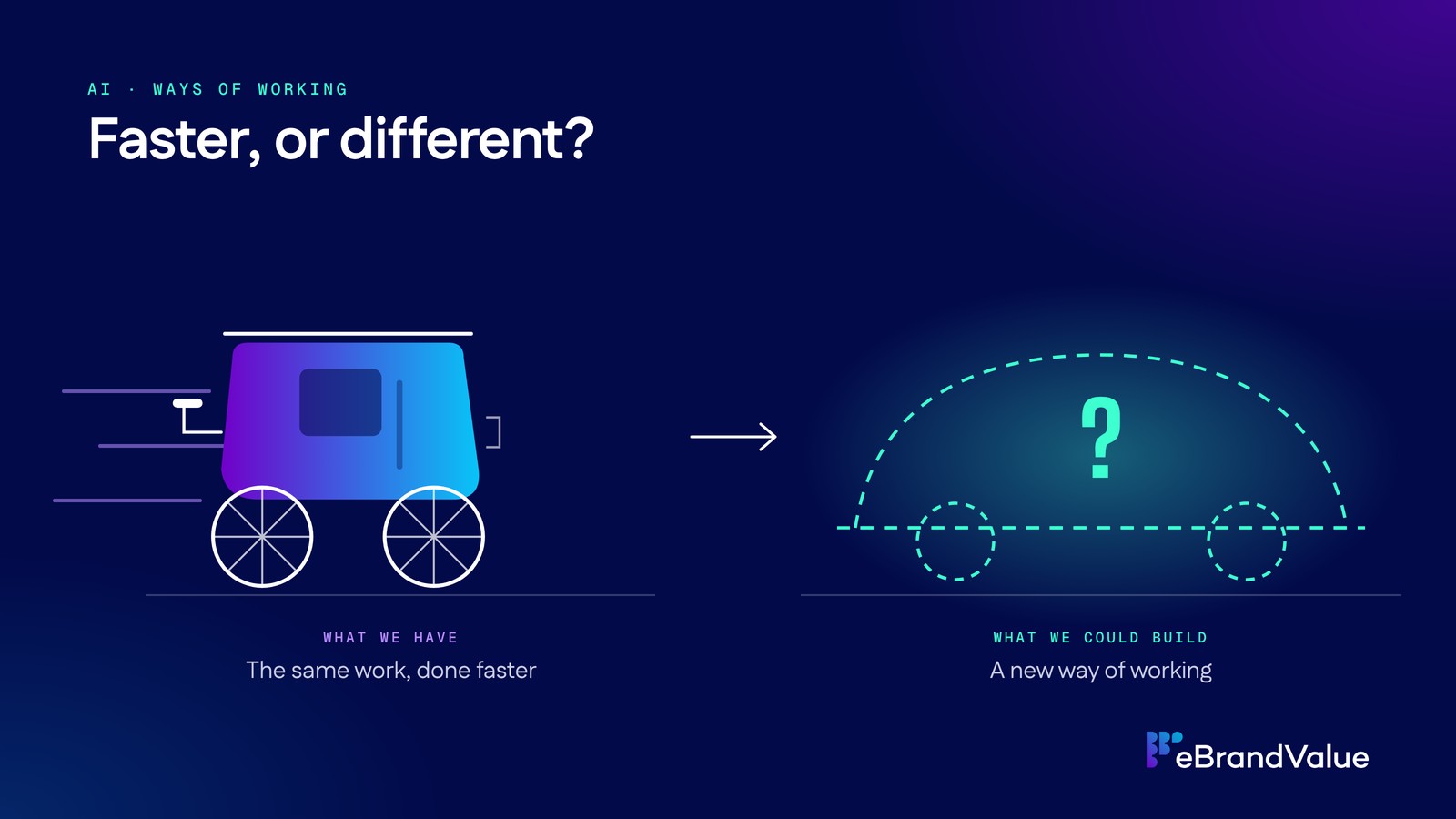
While thinking about this question, one analogy from the history of technology keeps coming back to me: the "horseless carriage."
When we first see a new technology, we make sense of it with the concepts of the world we already know. Calling the automobile a "horseless carriage" is one example. We can describe what is new, but we cannot yet fully see how it might change our lives.
I think we are in a similar place with AI today.
In "The 'Horseless Carriage' Fallacy," published in 2026, David Wall applies this analogy to how companies are organized. In a 2025 analysis, Bjorn Beam questions the use of AI that stops at summarizing documents and automating existing tasks. Both pieces ask the same question: are we judging the potential of a new technology within the limits of the old way of working? [1, 2]
For me, this question matters especially for the future of marketing.
Faster reports or earlier learning?
As Marketing Director at eBrandValue, I believe that measuring the value of AI by the number of reports or pieces of content it produces falls short. What we really need to assess is whether we understand the customer better, and how that understanding changes our decisions.
It is possible to analyze thousands of conversations about a brand. But what does that analysis tell us? Can we notice a shift in what consumers expect? Can we understand the need behind a complaint? Does the insight we gain turn into a decision about the product, the communication or the customer experience?
There is an important difference between a report being prepared faster and a brand learning sooner.
Let's think about it with a concrete example. Say AI classifies customer reviews and prepares the weekly report in a few minutes. If we are still waiting for the end-of-month meeting to discuss that report, the place where we gain speed and the place where we lose time have come apart.
What we may need to rethink here is how often we meet, who has the authority to decide and how information flows between teams. The benefit we get from a technology depends on the way of working we build around it.
What history tells us about new technology
This idea has a strong counterpart in economic history.
In "The Dynamo and the Computer," published in 1990, Paul A. David compares electrification with the spread of computers. One of the study's main lessons is that it can take time for technological investment to show up in productivity, and that the organization of production and the structures around it also have to change in the process. This is not a forecast that proves the future of AI. It is a useful historical frame for assessing the expectations we have today. [3]
I look at the Ford Model T from the same angle. The Model T came to market in 1908. Ford began developing the moving assembly line in 1913. The change in how cars were produced was decisive in making it possible to build the automobile at lower cost and on a much larger scale. The product and the way it was made developed together. [4, 5]
I believe companies need to think about these two areas together when it comes to AI: what possibilities does the technology offer us, and how do we build a structure that can work with those possibilities?
Start with the decision you want to improve
In marketing, the starting point may not be buying more tools. First, we need to describe clearly which decision we want to improve.
Do we want to notice customer loss earlier? Are we trying to understand a new need? Do we want to measure the impact of campaigns more reliably? Once the question is clear, we can also place the contribution of data, technology and people more accurately.

I think people's responsibility grows in this process. We need to question which data an output is based on, judge its context, see its errors and take ownership of the outcome of the decision we make. Speed does not remove that responsibility.
For me, the measure of a good transformation is this: Can teams ask more meaningful questions? Can they put what they learn into practice? Can they create value that makes a real difference in the customer's life?
I believe that when we talk about AI, we should also be talking about these things.
Because the power of the tools we have today will shape our future, and so will our courage to question our habits.
I would rather start with this question:
Thanks to AI, which work are we doing faster today, and which work do we now need to do differently?
Sources
- David Wall (February 18, 2026). The "Horseless Carriage" Fallacy: Why AI Won't Fix Your Organization. Medium. Link
- Bjorn Beam (April 28, 2025). Agents of Change: Why AI's Horseless Carriage Moment Demands a Cultural Revolution. LinkedIn. Link
- Paul A. David (1990). The Dynamo and the Computer: An Historical Perspective on the Modern Productivity Paradox. American Economic Review, 80(2), 355-361. Link
- The Henry Ford. Ford Motor Co. Chronology, 1903-2003. Link
- The Henry Ford. Henry Ford Assembly Line. Link
To learn more about eBrandValue Platform, and how such metrics influence brand value, contact us using the form below.